Why You Got an IRS Estimated Tax Penalty and How to Get It Removed
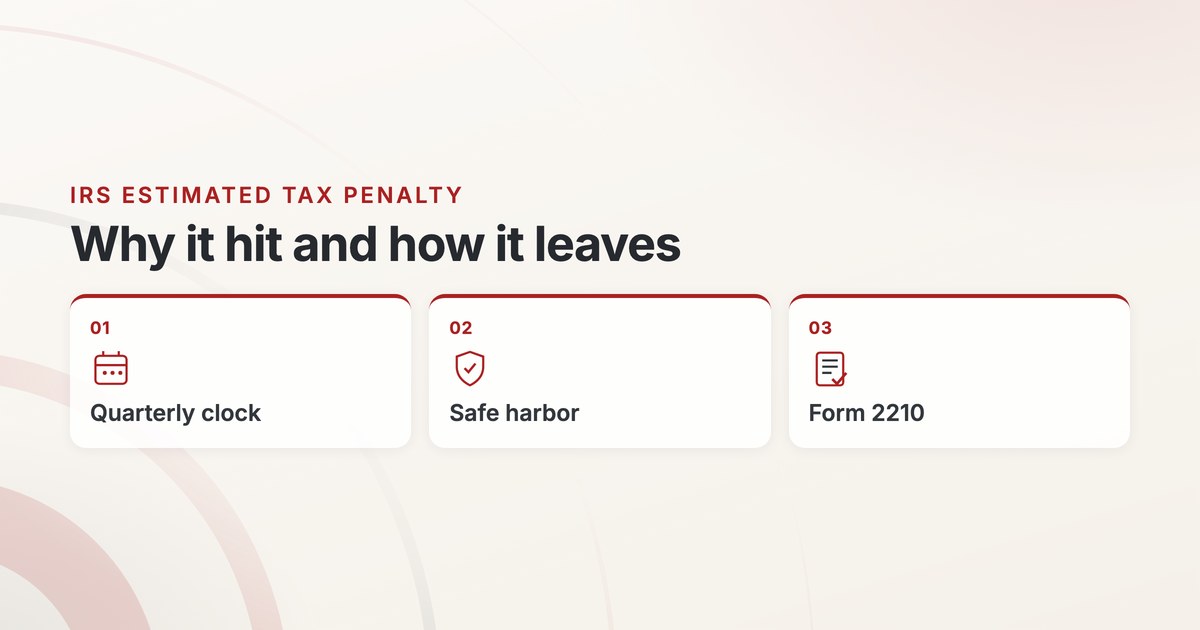
You filed, the math looked right, and there is still a line on the return you did not expect. It is usually small enough to be annoying rather than frightening, and it almost never comes with an explanation. What you are looking at is the penalty for underpaying estimated tax, and it is charged for a reason that has nothing to do with whether you paid the balance in full by April.
If a notice or a penalty line is sitting in front of you right now, call our Naperville office at 331-215-7663 or reach us through our Contact page.
Why You Got an Estimated Tax Penalty
The IRS treats income tax as a pay as you go tax. If your withholding and estimated payments did not cover enough of the year’s tax as you earned it, you owe a penalty on the shortfall even if you paid the whole balance on time in April. It is charged on what was missing at each payment date, not on what was left at the end.
That single idea explains most of the confusion. People read the penalty as a late payment charge and go looking for the date they missed. There is no such date. The charge is about timing across the year, and the underpayment is measured four separate times.
How the Penalty Is Actually Calculated
Quarter by Quarter, Not Once a Year
The year is cut into four payment periods, and each one has its own due date. For 2026 those dates are April 15, June 15, September 15, and January 15, 2027. The IRS compares what you should have paid in by each date against what you actually had in, and charges on whatever was short from that date until the shortfall was covered or the return was filed, whichever came first.
This is why a large fourth quarter payment does not undo the problem. Paying in December fixes December. It does nothing for a June shortfall that sat open for six months, which is the most common version of this we see in Naperville when a bonus, a distribution, or a good quarter of self-employment income lands early in the year and nothing is paid against it until the return is prepared.
The Rate the IRS Uses and Why It Moves
The charge is computed at the federal underpayment interest rate, which the IRS resets every quarter. It is currently 7 percent for the third quarter of 2026, and the IRS publishes the figure on its quarterly interest rates page each time it changes. Because the rate moves and each period is measured separately, two people with the same total shortfall can owe noticeably different amounts.
Call us at 331-215-7663 if the figure on your return does not look like anything you can reconstruct. Reconstructing it is usually the fastest way to find out whether it was computed against the right numbers.
The 110 Percent Rule and the Safe Harbors That Stop It Before It Starts
There are three ways to be outside this penalty entirely, and all three are worth knowing because they are the difference between a fixable habit and a recurring line item.
The first is size. If you owe less than $1,000 in tax after subtracting withholding and refundable credits, the penalty does not apply. The second is current year coverage, which means paying in at least 90 percent of the tax shown on this year’s return. The third is prior year coverage, which means paying in 100 percent of the tax shown on last year’s return, on a return that covered all twelve months. The IRS sets all three out in Topic 306.
The prior year figure is where higher earners get caught. If your adjusted gross income for the prior year was more than $150,000, or more than $75,000 filing separately, the prior year safe harbor rises to 110 percent rather than 100 percent, as Publication 505 sets out. People who cross that income line for the first time often pay in exactly last year’s tax, assume they are covered, and find they were 10 percent short of the harbor all year.
The prior year route is the one to reach for when your income is genuinely unpredictable, because it is a fixed number you can hit in four equal installments without forecasting anything.
Can You Be Penalized for Overpaying
No. Overpaying estimated tax does not create a penalty. It creates a refund, or a credit forward if you elect one.
The reason this question comes up is that people who receive income unevenly sometimes get penalized despite paying more than enough in total. Four equal installments are what the default calculation expects. If two thirds of your income arrives in the fourth quarter and you pay accordingly, the earlier periods still read as short. The fix is the annualized installment method, which matches each period’s required payment to the income actually earned in it, and it is claimed on the same form used to compute the penalty.
Getting the Penalty Removed After the Fact
Form 2210 and the Waiver Boxes
Form 2210 is where the penalty is computed, and it is also where it is contested. Filing it lets you use the annualized method instead of the equal installment assumption, which frequently reduces the charge on its own without any argument about relief.
The form also carries the waiver request. The law allows the IRS to waive the penalty where the required payment was missed because of a casualty, disaster, or other unusual circumstance and imposing the penalty would be inequitable, or where you retired after reaching age 62 or became disabled during that tax year or the one before, and the underpayment was due to reasonable cause rather than willful neglect. Those are narrow grounds, and they are the grounds that exist.
Why First Time Abatement Usually Does Not Reach This One
If you have already looked at first time abatement, the answer here is short and worth having early. That relief covers failure to file, failure to pay, and failure to deposit, and the IRS penalty relief rules do not extend it to the estimated tax penalty. A clean compliance history helps you elsewhere. It does not remove this charge.
What We Do on Your Behalf
Our first step is almost always to pull the account transcript rather than argue from the return, because the transcript shows what the IRS actually posted and when, and mismatches between payments made and payments credited are more common than people expect. From there the work splits three ways. We recompute the year on an annualized basis where the income was uneven. We request the waiver where the facts genuinely fit one of the statutory grounds. And we file the authorization so the IRS deals with us instead of with you.
As enrolled agents we hold unlimited practice rights before the IRS, so a Form 2210 recomputation, a waiver request, and any follow up correspondence can be handled entirely on your behalf. Our About Us page sets out the team and the credentials.
If this penalty is one part of a larger balance, our penalty abatement page covers the wider relief work. Our guide to getting IRS penalties removed even when you owe thousands covers the reasonable cause route for the penalties this one is not.
Illinois Charges Its Own Version
Illinois runs a separate estimated payment requirement with a separate penalty, administered by the Illinois Department of Revenue rather than the IRS. It is a different agency, a different form, and a different calculation, and paying the federal shortfall does nothing about the state one. Plenty of DuPage County households owe both in the same year. We cover the Illinois side in its own post, and our Naperville IDOR dispute services page describes the state representation work.
If the Penalty Is Already on Your Account
Work out first whether the charge is arithmetic or relief. If your income was uneven, the annualized method on Form 2210 is arithmetic and it belongs on an amended computation. If the year was disrupted by something the statute recognizes, the waiver is the route. If neither fits, the penalty stands, and the useful work is making sure next year’s payments clear a safe harbor so it does not repeat.
Bring us the return and the notice in a Free Confidential IRS Case Evaluation and we will tell you which of those three you are in. Call 331-215-7663 or reach us through our Contact page, and if penalties and interest are stacking on top of each other we will map the whole account, not just this line. You’ll Leave With a Clear IRS Action Plan – Whether You Hire Us or Not. Amit Maheshwari, EA (Enrolled Agent, Licensed to Practice before the IRS).
FAQ
Why am I getting an estimated tax penalty?
Because your withholding and estimated payments did not cover enough of the year’s tax as you earned it. The IRS charges on the shortfall at each of the four payment dates, so you can owe this penalty even if the balance was paid in full on time.
What is the 110% rule for estimated tax payments?
If your prior year adjusted gross income was over $150,000, or over $75,000 if you file separately, the prior year safe harbor is 110 percent of last year’s tax rather than 100 percent, as Publication 505 sets out. Paying in exactly last year’s tax leaves you short of the harbor.
Is there a penalty for being late on estimated taxes?
Yes, and it is charged from the missed installment date rather than from the filing deadline. A late third quarter payment is charged from September 15 until the shortfall is covered.
How to get rid of estimated tax penalty?
Two routes. Recompute the year on Form 2210 using the annualized installment method if your income was uneven, which often reduces the charge outright, or request the statutory waiver if a casualty, disaster, retirement after 62, or disability caused the missed payment.

Written by
Amit Maheshwari, EA (Enrolled Agent, Licensed to Practice before the IRS)
Tax Resolution Specialist at Taxx Resolution Inc
Amit is an Enrolled Agent credentialed with the IRS. As a seasoned Entrepreneur, he brings a wealth of experience and a commitment to assisting small businesses in achieving financial peace of mind. From IRS disputes and audits to tax debt resolution, he helps alleviate the burdens that can impede the growth and success of businesses. With a keen understanding of tax laws and regulations, he strives to provide solutions specific to the client's situation.
Need Help With Your Tax Situation?
Book a no-obligation tax resolution case evaluation with a licensed tax professional.
Case Evaluation
Book a no-obligation tax resolution case evaluation with a licensed tax expert today.
(331) 215-7663