Illinois Tax Payment Plan, How to Set One Up With IDOR and What to Expect
The Illinois Department of Revenue does not send as much mail as the IRS, so an Illinois balance tends to sit ignored until a refund disappears or a levy shows up. It is a smaller agency with a shorter fuse than most people expect, and it will put you on a payment plan if you ask before it decides to collect on its own terms.
If you owe Illinois and want to know what a realistic plan looks like, call our Naperville office at 331-215-7663 or use the Contact page.
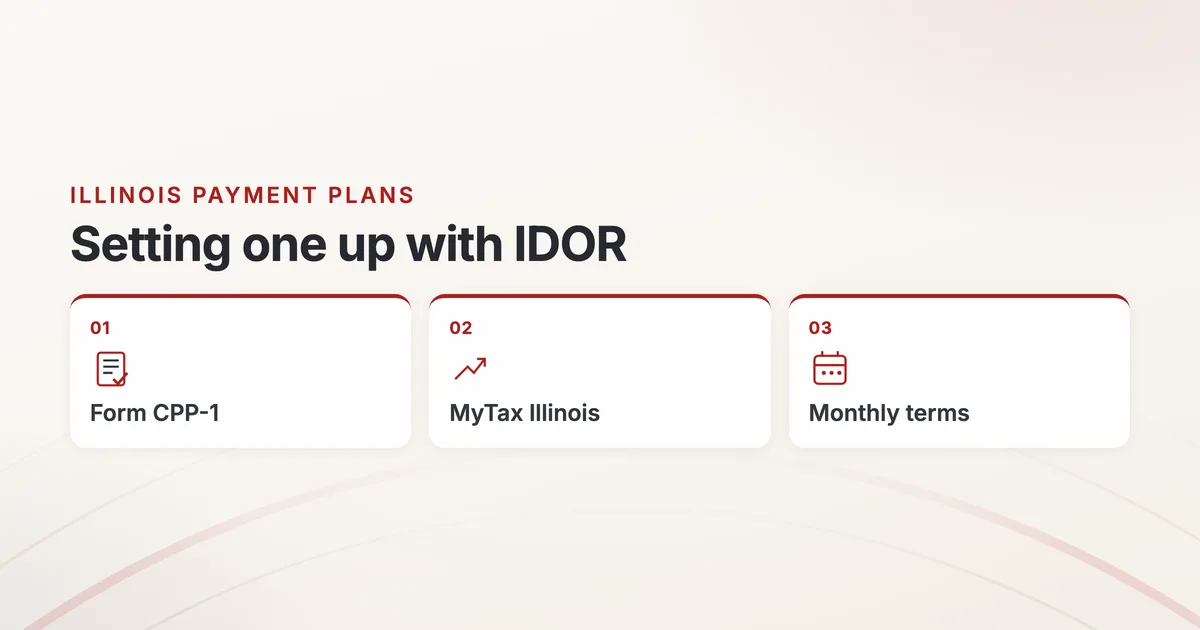
How to Request an IDOR Payment Plan Using Form CPP-1 or MyTax Illinois
Illinois runs this as a formal request rather than a phone call, and there are two doors into the same process. The right one depends on how your account is set up.
The CPP-1 Installment Payment Plan Request
Form CPP-1 is the Installment Payment Plan Request. You identify the tax types and periods, state the balance, propose a monthly payment and a payment date, and supply the financial details the form asks for. Complete it fully, because an incomplete request is the most common reason a plan stalls before anyone reviews it.
Setting up a plan through MyTax Illinois
MyTax Illinois is the department’s online account system, and a plan request can be submitted and monitored there. It is also where you can see exactly which periods are open and what has posted, which is worth checking before proposing a number. Confirm the current process on tax.illinois.gov before you file, since the department updates its forms and online flows periodically.
Terms, duration, and what IDOR expects while you pay
Expect a defined monthly amount, a fixed due date, and a requirement to stay current on everything going forward. Filing a later return late, or underpaying the next year, is the usual way a plan dies. If your circumstances change, contact the department before you miss a payment rather than after.
Does Illinois Allow Payment Plans for Taxes
Yes. The Illinois Department of Revenue offers an installment payment plan for taxpayers who cannot pay a balance in full, for individual income tax and for many business tax types. It is a formal arrangement, not an informal promise to send money when you can, and it has to be requested and approved.
The trade you are making is straightforward. You get a scheduled monthly payment and, while you keep it, the department generally holds off on the enforcement it would otherwise pursue. What you do not get is a pause on interest and penalties, which continue to accrue on the balance until it is paid.
How Do I Qualify for a Tax Payment Plan
Illinois looks at three things before approving a plan. Are all your required Illinois returns filed. Can you document that you cannot pay the balance in full. And can you commit to a monthly amount that retires the balance in a reasonable period.
Larger balances draw more scrutiny and may require financial information supporting the amount you propose. The department may also ask for a down payment, may require payments by direct debit, and may protect its position by filing a state tax lien even while a plan is active. None of that is a rejection. It is the department managing risk, and it is worth knowing before you are surprised by it.
A word on the number you propose. People tend to offer whatever clears the balance fastest, then miss the third payment when a car repair lands. The department is far more accommodating about the size of a payment at the start than it is about a default later, so propose something you can pay in a bad month, not a good one.
What Happens If I Owe Illinois State Taxes
Unpaid Illinois balances follow a path. Notices first, with penalties and interest building. Then the department can offset your Illinois refund, refer the account for collection, issue a wage levy, levy a bank account, file a state tax lien against your property, and in some cases affect professional licenses and registrations.
The important part for Naperville taxpayers is that this happens on a separate schedule from anything the IRS is doing. Being in good standing with the IRS does not slow the state down by a day. We handle the state side through our Illinois Department of Revenue dispute services.
What Is the Deadline to Pay Illinois State Taxes
Illinois individual income tax is due on the original due date of the return, which normally falls in mid April alongside the federal deadline. An extension of time to file is not an extension of time to pay, and interest runs from the original due date regardless of any extension.
If you cannot pay by that date, still file on time. Filing late and paying late is two problems. Filing on time and paying late is one, and it is the one a payment plan is designed to solve.
Two Agencies, Two Balances, Two Separate Applications
Two agencies, two balances, two applications. An approved federal installment agreement does nothing for an Illinois balance, and an approved Illinois plan does nothing for a federal one. Each has its own forms, its own review, and its own default consequences.
Households that owe both need the monthly numbers built together rather than separately, because two plans negotiated in isolation frequently add up to more than the household can actually pay, and then both default. If the federal side is the larger problem, our post on negotiating a payment plan with the IRS explains that process, and our installment agreements page covers the federal terms.
When the Monthly Number Simply Does Not Work
Sometimes the balance is too large for any monthly figure that leaves the household solvent. When that is the case, the conversation shifts to whether the liability itself is correct, whether penalties can be reduced, and whether the state has a settlement route available for your circumstances. A plan you cannot sustain is worse than no plan, because default resets the department’s collection options.
If the balance covers several years, our post on resolving multi year back taxes is the place to start, and our Naperville tax resolution services page shows what we take on.
Frequently Asked Questions
Does Illinois allow payment plans for taxes?
Yes. The Illinois Department of Revenue approves installment payment plans for taxpayers who cannot pay in full. Interest and penalties continue to accrue while the plan runs.
How do I qualify for a tax payment plan?
File all required Illinois returns, show that you cannot pay the balance in full, and propose a monthly amount that clears it in a reasonable period. Larger balances may require financial documentation and a down payment.
What happens if I owe Illinois state taxes?
Penalties and interest accrue, then the department can offset refunds, refer the account to collections, levy wages or bank accounts, and file a state tax lien.
What is the deadline to pay Illinois state taxes?
Payment is due on the original return due date, normally mid April. Filing an extension does not extend the time to pay, and interest runs from the original due date.
Free Confidential IRS Case Evaluation on Your Illinois Tax Balance
Owe the Illinois Department of Revenue? We handle IDOR payment plans and disputes from right here in Naperville. A Free Confidential IRS Case Evaluation is usually enough to show you what the department is likely to accept. Call 331-215-7663 or reach us through the Contact page. You’ll Leave With a Clear IRS Action Plan – Whether You Hire Us or Not. Amit Maheshwari, EA (Enrolled Agent, Licensed to Practice before the IRS).

Written by
Amit Maheshwari, EA (Enrolled Agent, Licensed to Practice before the IRS)
Tax Resolution Specialist at Taxx Resolution Inc
Amit is an Enrolled Agent credentialed with the IRS. As a seasoned Entrepreneur, he brings a wealth of experience and a commitment to assisting small businesses in achieving financial peace of mind. From IRS disputes and audits to tax debt resolution, he helps alleviate the burdens that can impede the growth and success of businesses. With a keen understanding of tax laws and regulations, he strives to provide solutions specific to the client's situation.
Need Help With Your Tax Situation?
Book a no-obligation tax resolution case evaluation with a licensed tax professional.
Case Evaluation
Book a no-obligation tax resolution case evaluation with a licensed tax expert today.
(331) 215-7663