Four Payroll Tax Penalty Tiers Run From 2 Percent to 15 Percent
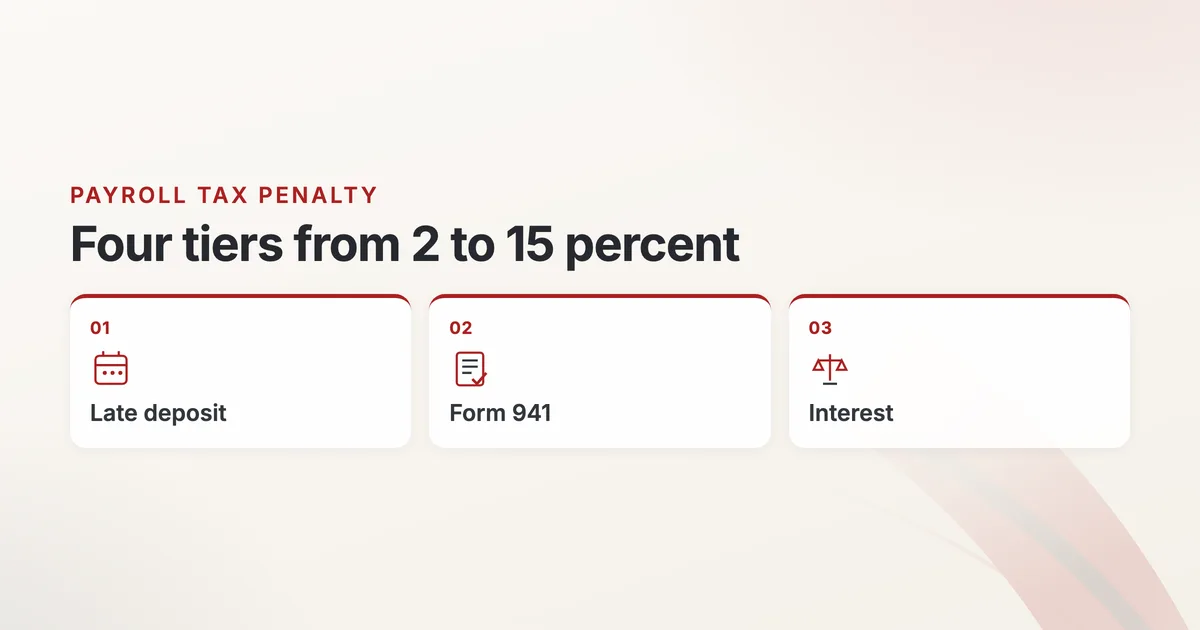
When a business deposits payroll taxes late, the IRS charges a failure to deposit penalty of 2%, 5%, 10% or 15% of the unpaid deposit, depending on how late it is. A late Form 941 and an unpaid balance add their own penalties, interest runs on top, and unpaid withholding can become a personal bill for the owners.
That’s why payroll debt deserves more urgency than an income tax balance of the same size. The people who decide which bills get paid can end up owing the withheld tax itself.
If deposits have already been missed, call us at 331-215-7663 or reach us through our Contact page before the next deposit date passes.
What Is the Penalty for Paying Payroll Taxes Late?
The penalty is a percentage of the deposit that didn’t arrive on time, and the IRS sets it by counting calendar days from the deposit’s due date. Its Failure to Deposit Penalty page publishes four tiers.
| Days the deposit is late | Penalty (IRS rate) |
|---|---|
| 1 to 5 calendar days | 2% of the unpaid deposit |
| 6 to 15 calendar days | 5% of the unpaid deposit |
| More than 15 calendar days | 10% of the unpaid deposit |
| More than 10 days after the first IRS notice, or the day a notice demanding immediate payment arrives | 15% of the unpaid deposit |
The tiers replace each other rather than adding up, as the IRS spells out. A deposit that’s 20 days late carries 10%, not 2% plus 5% plus 10%. The top tier is the one to watch, because it’s triggered by the IRS’s own letters rather than by the calendar alone, so ignoring a notice moves the business up a level.
The Penalties That Stack on Top
A late deposit is rarely the only charge on the account, because the same cash shortfall that delays a deposit tends to delay the return and the payment too.
Filing Form 941 Late
If the quarterly return itself is late, the IRS charges a failure to file penalty of 5% of the unpaid tax for each month or part of a month, up to 25%. Publication 15 sets out the rate. Filing on time is the cheapest fix available even when the money isn’t there, because the filing penalty is the larger of the two monthly charges.
Paying the Balance Late
Tax still unpaid after the return’s due date picks up a failure to pay penalty of 0.5% a month, also capped at 25%. When both apply in the same month, the filing penalty is reduced by the payment penalty, so the two don’t fully double.
Interest
The IRS charges interest on the unpaid tax and on the penalties themselves. It accrues until the balance is paid, and by law the IRS can’t remove interest unless the penalty it sits on is removed or reduced.
What Triggers the Penalty in the First Place
A deposit can be penalized for being late, for being short, or for being made the wrong way. The IRS names all three on its penalty page, and each one catches businesses that thought they’d paid.
The schedule is the usual culprit. Employers deposit monthly or semiweekly depending on their past liability, and under the next-day deposit rule a business that accumulates $100,000 or more of tax on any day has to deposit by the next business day, which also moves it onto the semiweekly schedule. Owners who grow past a threshold without noticing miss deposits they didn’t know were due.
The method matters too. Deposits generally have to be made electronically, so a check sent where an electronic deposit was required can still count as a failed deposit. And a payment credited to the wrong quarter leaves the right quarter short. Our post on what causes payroll tax problems walks through the patterns behind those mistakes.
This is a different charge from the estimated tax penalty individuals see on their own returns. The two are sometimes confused because both are about timing, but they’re calculated under different rules.
When the IRS Stops Charging the Business and Looks at the People
If withheld income tax and the employee share of Social Security and Medicare go unpaid, the IRS can assess the Trust Fund Recovery Penalty against the individuals responsible. The Form 941 instructions put it at 100% of the unpaid trust fund tax, assessed against people who were responsible for paying it and willfully didn’t.
How Payroll Penalties Get Reduced
There are three routes, and they work best in this order.
Designating Deposits
The IRS normally applies a deposit to the most recent liability in the quarter, which can leave an earlier period looking late when it wasn’t the problem. Publication 15 lets a business tell the IRS how to apply its deposits to lower the penalty, as long as it does so within 90 days of the penalty notice. It’s arithmetic rather than relief, and it’s often the fastest reduction available.
Reasonable Cause and First-Time Relief
The IRS may remove or reduce the penalty when the business acted in good faith and can show reasonable cause. Separately, its first-time abatement rules list the failure to deposit penalty among those that can be waived for a business with a clean recent compliance history. Our penalty abatement work covers how those requests are built and supported.
Getting Current
None of this sticks if deposits are still being missed. A payment plan can also reduce future penalties, the IRS notes, but only once the business has stopped adding new quarters to the balance.
What We Do First When a Business Calls Us Behind on Deposits
We start with the deposits that haven’t come due yet. The IRS won’t agree to any payroll resolution while new quarters are still going unpaid, so current compliance is step one on every case we take through our help with payroll tax debt.
Then we pull the transcripts and split the balance into its trust fund and non-trust fund portions. That split decides how much personal exposure the owners face and which penalties are worth contesting. Amit Maheshwari, EA (Enrolled Agent, Licensed to Practice before the IRS), counts payroll tax issues and Trust Fund Recovery Penalty defense among his practice areas and has run businesses himself, so the plan we build keeps the doors open while the back balance is paid.
If your business is behind on payroll taxes, book a Free Confidential IRS Case Evaluation. Call 331-215-7663 or reach us through our Contact page, and bring your latest notices and Forms 941. You’ll Leave With a Clear IRS Action Plan – Whether You Hire Us or Not.
FAQ
What is the penalty for paying payroll taxes late?
The IRS charges 2% of the unpaid deposit if it’s 1 to 5 days late, 5% at 6 to 15 days, and 10% after 15 days. It rises to 15% once more than 10 days pass after the first IRS notice. Late filing, late payment and interest are charged separately.
What triggers a tax penalty?
For payroll, the trigger is a deposit that’s late, short, or made the wrong way, such as a check where an electronic deposit was required. Filing Form 941 late and leaving the balance unpaid after the due date each trigger their own penalty.
What is a 941 penalty?
It’s any penalty tied to the quarterly Form 941, most often the failure to deposit penalty. Under Publication 15, a 941 filed late carries 5% of the unpaid tax per month, up to 25%, and unpaid tax adds 0.5% per month, also up to 25%.
What is the penalty for failing to withhold payroll taxes?
If income tax, Social Security or Medicare that should have been withheld isn’t withheld or isn’t paid over, the IRS can assess the Trust Fund Recovery Penalty. The Form 941 instructions set it at 100% of the unpaid trust fund tax, and it falls on the people responsible who willfully didn’t pay it.

Written by
Amit Maheshwari, EA (Enrolled Agent, Licensed to Practice before the IRS)
Tax Resolution Specialist at Taxx Resolution Inc
Amit is an Enrolled Agent credentialed with the IRS. As a seasoned Entrepreneur, he brings a wealth of experience and a commitment to assisting small businesses in achieving financial peace of mind. From IRS disputes and audits to tax debt resolution, he helps alleviate the burdens that can impede the growth and success of businesses. With a keen understanding of tax laws and regulations, he strives to provide solutions specific to the client's situation.
Get our IRS and Illinois tax updates first in Google search.
Add us as a preferred source on GoogleNeed Help With Your Tax Situation?
Book a no-obligation tax resolution case evaluation with a licensed tax professional.
Case Evaluation
Book a no-obligation tax resolution case evaluation with a licensed tax expert today.
(331) 215-7663