The Illinois Voluntary Disclosure Program Closes the Moment IDOR Contacts You
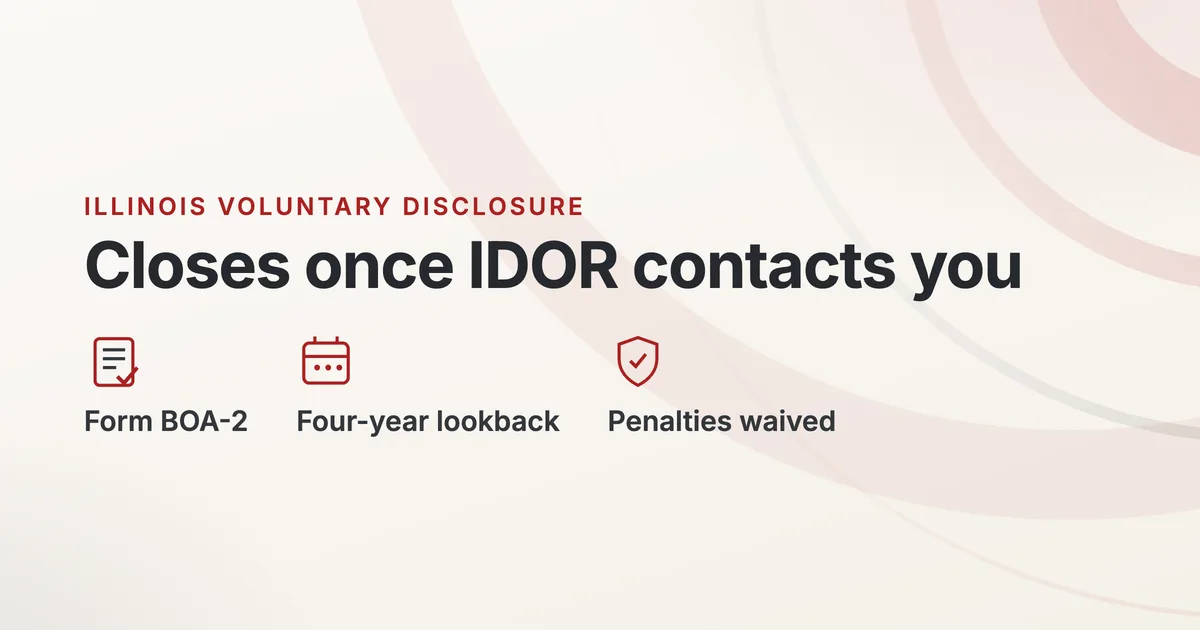
The Illinois Voluntary Disclosure Program is the Illinois Department of Revenue’s route for individuals and businesses that owe Illinois tax they never filed or paid. You apply on Form BOA-2 before IDOR contacts you. If you’re approved, you file and pay for no more than four years, and the penalties on those years are waived.
That makes it one of the few places in Illinois tax law where acting first changes the bill. It’s also easy to lose, because the protection only exists until the department reaches you on its own.
If you already know there are Illinois years missing, call us at 331-215-7663 or reach us through our Contact page before anything goes to IDOR.
What Is the Purpose of the Illinois Voluntary Disclosure Program?
The purpose is to bring noncompliant taxpayers back into the system on terms that are better than an audit. IDOR’s own Voluntary Disclosure Program page lists three benefits. The lookback period is limited to four years, penalties tied to the disclosed liability are eliminated once the tax and interest are paid within 60 days of billing, and any audit is limited to the approved four-year period.
Without the program, a year you never filed can be assessed at any time under the Uniform Penalty and Interest Act (35 ILCS 735/3-10). The regulation behind it, 86 Ill. Adm. Code 210.126, ties the four-year limit directly to the voluntary disclosure, which is why the order of events matters so much.
One naming point before going further. The Illinois State Treasurer, the City of Chicago and Cook County each run programs with the same name. The Treasurer’s version covers unclaimed property and the city and county versions cover their own local taxes. This post is about IDOR’s program for state tax.
Who Can Still Use It
The deciding question is whether IDOR got to you first. Under 210.126, you don’t qualify if the department started an audit or an investigation before your application was received.
When IDOR Has Already Contacted You
An audit counts as started once the Audit Bureau has contacted you to schedule one, or has written to you about a possible liability or an intent to audit, for the tax type you want to disclose. A criminal investigation file does the same. A partnership adds a wrinkle, since an audit of the partnership or a general partner counts as an audit of every partner for that partnership’s liability.
A routine letter about a different tax type doesn’t close the door by itself, because the test looks only at the tax you’re disclosing. We read every notice you’ve received before anything is filed.
Individuals, Businesses and Out-of-State Sellers
The program is written for any taxpayer, individual or business. That includes a business based outside Illinois that has only now learned it owed Illinois tax, and an owner who collected sales tax or withheld from paychecks and didn’t send it in.
If you collected tax and kept it, that money has to be paid for every period, including years older than the four-year window. IDOR lists that as a disqualifier.
What the Program Changes
It changes how far back the state can reach and what gets added on top.
The Lookback Period
Instead of every unfiled year, you file for the last four years. If you believe you didn’t owe Illinois tax for part of that stretch, the regulation lets you file only for the periods you believe you were required to, with your reasons stated in the application. IDOR then decides how many of the four years apply.
Penalties and Interest
Penalties on the disclosed years are waived once the tax and interest are paid on time. Interest isn’t waived. It accrues on each year’s unpaid tax, which is why an old year can still carry a real balance even with the penalties removed.
How a Voluntary Disclosure Is Made
It moves in a fixed order, and every step has a clock.
The Application Comes First
You or your representative files Form BOA-2 with IDOR’s Problems Resolution Division, along with an Illinois business registration if you don’t have one. If someone will represent you, a signed Form IL-2848 power of attorney goes in with it. The application isn’t accepted until a Board of Appeals member signs it, and that can only happen after the department confirms it hadn’t already opened an audit or investigation.
The Returns and Payment That Follow
After approval, you have 30 days to file the returns and pay the tax. A 60-day extension is available if you ask in writing inside that first 30 days. When the returns are processed, IDOR bills the interest and any remaining tax, and you have 60 days to pay it.
The department keeps the right to audit the disclosed years. Under subsection (e) of 210.126, if it finds you understated the liability by 10% or more and you can’t show a good faith effort, the relief is lost. The numbers you file need to be ones you can defend.
When Voluntary Disclosure Is the Wrong Route
It’s the wrong route when IDOR has already reached you, and it’s often unnecessary when the only problem is one or two recent years with no special exposure. In those cases, filing the missing returns directly is usually simpler, and our guide on what happens when Illinois returns go unfiled covers that path.
It also isn’t the same thing as amnesty. Illinois ran a time-limited amnesty in 2025, and our Illinois tax amnesty guide explains what that program was and what’s left now that it has closed.
People also ask how long the state of Illinois can collect back taxes. Once IDOR files a lien in the State Tax Lien Registry, section 1-25 of the State Tax Lien Registration Act (35 ILCS 750/1-25) keeps it in force for 20 years from the filing date. That’s a strong reason to come forward while the choice is still yours.
How We Handle an Illinois Disclosure Alongside the IRS
An Illinois gap rarely sits alone. The same missing years are often missing on the federal side too, and filing Illinois returns that report income the IRS never saw invites a federal question.
So we look at both at once. If federal years are open, our unfiled federal returns work runs alongside the state application, and the returns are built from the same records. On the Illinois side, we prepare the BOA-2, file the IL-2848, and handle the department’s follow-up through our representation before the Illinois Department of Revenue. We keep the 30-day and 60-day deadlines in view so a missed date doesn’t undo an approved application.
Before any application goes in, we confirm there’s no audit contact that would disqualify you. Filing a disclosure you can’t use tells the state you owe without buying any protection.
Next Steps
If there are Illinois years you haven’t filed, book a Free Confidential IRS Case Evaluation. Call 331-215-7663 or reach us through our Contact page, and we’ll tell you whether voluntary disclosure fits and what the four years are likely to cost. You’ll Leave With a Clear IRS Action Plan – Whether You Hire Us or Not. Amit Maheshwari, EA (Enrolled Agent, Licensed to Practice before the IRS).
FAQ
What is the purpose of a voluntary disclosure program?
It gives taxpayers who never filed a way back into compliance on better terms than an audit. In Illinois, an approved disclosure limits the lookback to four years and waives the penalties on those years once the tax and interest are paid on time.
How long can the state of Illinois collect back taxes?
A lien IDOR files in the State Tax Lien Registry stays in force for 20 years from the date it’s filed, under 35 ILCS 750/1-25. The department can file that lien within three years after a liability becomes final.

Written by
Amit Maheshwari, EA (Enrolled Agent, Licensed to Practice before the IRS)
Tax Resolution Specialist at Taxx Resolution Inc
Amit is an Enrolled Agent credentialed with the IRS. As a seasoned Entrepreneur, he brings a wealth of experience and a commitment to assisting small businesses in achieving financial peace of mind. From IRS disputes and audits to tax debt resolution, he helps alleviate the burdens that can impede the growth and success of businesses. With a keen understanding of tax laws and regulations, he strives to provide solutions specific to the client's situation.
Get our IRS and Illinois tax updates first in Google search.
Add us as a preferred source on GoogleNeed Help With Your Tax Situation?
Book a no-obligation tax resolution case evaluation with a licensed tax professional.
Case Evaluation
Book a no-obligation tax resolution case evaluation with a licensed tax expert today.
(331) 215-7663