Settle the IDOR Balance Before an Illinois Bulk Sales Closing (Or Your Buyer Holds the Money)
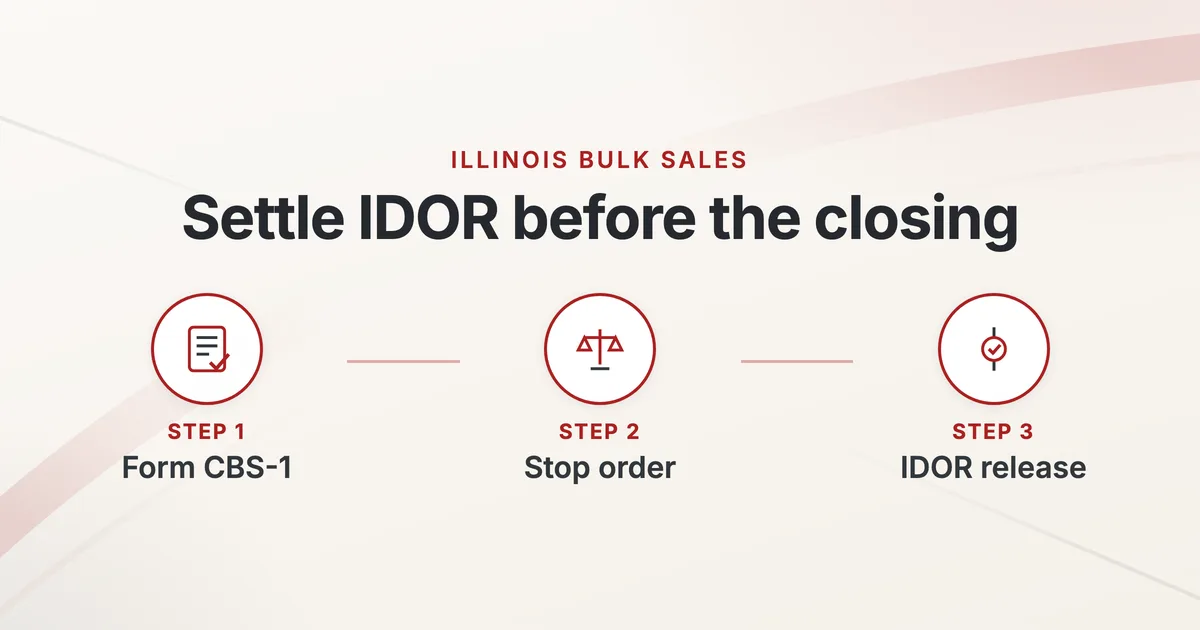
Yes, Illinois still has a bulk sales requirement. When a business sells most of its inventory, equipment or property outside its normal course of business, the buyer has to file Form CBS-1 with the Illinois Department of Revenue at least 10 business days before closing. If the seller owes IDOR, the department can order the buyer to hold back part of the price.
That order is what people call a stop order, and it’s how an old sales tax or withholding balance can hold up a sale that’s otherwise ready to close.
Selling and unsure what IDOR shows on your account? Call us at 331-215-7663 or reach us through our Contact page before a closing date is set.
The Illinois Bulk Sales Notice Still Applies
Does Illinois have a bulk sales law? It does, in two statutes. IDOR’s Form CBS-1 instructions cite section 5j of the Retailers’ Occupation Tax Act and section 902(d) of the Illinois Income Tax Act. A bulk sale happens when a business, outside its usual course, sells or transfers the major part of its stock of goods, its furniture or fixtures, its machinery and equipment, or its real property.
The buyer must file the notice, and the seller may file one too. It goes in with a copy of the sales contract, signed by both sides, and the financing agreement. Those need to show what’s being sold, the price or other consideration, and how the price will be paid.
Two follow-up rules trip people up. If the terms change after filing, an updated CBS-1 has to go in right away with the revised contract. If the sale falls through, IDOR wants a signed letter explaining why.
What Is a Bulk Sales Stop Order in Illinois?
A bulk sales stop order is IDOR’s written order telling the buyer to withhold part of the purchase price because the seller may owe Illinois tax. Under section 902(d), the department issues it within 10 business days after it receives the notice, and the buyer holds the money until IDOR certifies that nothing is owed.
The amount isn’t open-ended. The regulation, 86 Ill. Adm. Code 130.1701, caps it at a minimum set by business type, plus twice the seller’s unpaid liabilities and an allowance for any returns that weren’t filed when due. Within 60 business days of the first order, IDOR has to tell the buyer the actual amount due.
The timing works in the buyer’s favor if the department misses it. If IDOR doesn’t send the withholding order within 10 business days of the notice, or the final amount within 60 business days of the first order, the statute relieves the buyer of the duty to keep withholding.
What the Buyer Is Exposed to if the Notice Is Missed
A buyer who doesn’t file on time becomes personally liable for what the seller owes IDOR, up to the reasonable value of the property acquired. The CBS-1 instructions say so directly.
That turns the seller’s old tax problem into the buyer’s new one. It’s also why a careful buyer won’t close without the notice on file, and why a seller with an IDOR balance should expect the question to come up.
What the Seller Needs to Settle With IDOR Before Closing
IDOR issues a bulk sales release only after every tax, penalty and interest charge is paid. For a seller, that makes the account the real closing condition.
Finding the Real Balance
Start with what the department actually has on file for every tax type the business was registered for, especially sales tax and withholding. State balances are often built from estimated assessments or letters that were never answered, and a figure like that is worth challenging before it’s paid out of the sale proceeds. Our guide on how IDOR collects explains where those balances come from.
Clearing It or Getting It Released
If the balance is right, the cleanest path is paying it before closing so the release can issue. If a lien is already recorded, our Illinois tax liens guide covers how registry liens are cleared. And if returns were never filed for some periods, they need to be filed first, since IDOR can base the withholding on returns that weren’t filed when due. Our guide on catching up on Illinois back taxes walks through that step.
Cook County and Chicago Have Their Own Rules
The state notice isn’t the only one. Cook County and the City of Chicago run their own bulk sales requirements for their own taxes, and a sale in either area may need those filings as well. The state rules above don’t satisfy them.
How We Work With the Seller’s IDOR Side of a Sale
We don’t draft purchase agreements. That belongs to the deal’s attorneys. Our part is the seller’s Illinois tax account, because that’s the balance a stop order is waiting on.
With a Form IL-2848 on file, we pull the account detail, confirm which periods and tax types are open, and file anything missing. We challenge balances that were estimated, then pay or structure what’s left so the release can issue. If the business also owes the IRS, we run both at once through our work on clearing the seller’s IDOR balance and the federal case.
Amit Maheshwari, EA (Enrolled Agent, Licensed to Practice before the IRS), and our team can review your account before your buyer files the notice. Book a Free Confidential IRS Case Evaluation by calling 331-215-7663 or through our Contact page, and bring your latest IDOR notices and the proposed closing date. You’ll Leave With a Clear IRS Action Plan – Whether You Hire Us or Not. We’ll tell you what IDOR is likely to ask for before you sign.
FAQ
Does Illinois have a bulk sales law?
Yes. Under section 902(d) of the Illinois Income Tax Act and section 5j of the Retailers’ Occupation Tax Act, a buyer taking the major part of a business’s inventory, equipment or property outside the normal course must file Form CBS-1 at least 10 business days before the sale.
What is a bulk sales stop order in Illinois?
It’s IDOR’s order telling the buyer to withhold part of the purchase price when the seller may owe Illinois tax. The buyer keeps holding the money until IDOR issues a certificate showing nothing is owed, and a release comes only after all tax, penalties and interest are paid.

Written by
Amit Maheshwari, EA (Enrolled Agent, Licensed to Practice before the IRS)
Tax Resolution Specialist at Taxx Resolution Inc
Amit is an Enrolled Agent credentialed with the IRS. As a seasoned Entrepreneur, he brings a wealth of experience and a commitment to assisting small businesses in achieving financial peace of mind. From IRS disputes and audits to tax debt resolution, he helps alleviate the burdens that can impede the growth and success of businesses. With a keen understanding of tax laws and regulations, he strives to provide solutions specific to the client's situation.
Get our IRS and Illinois tax updates first in Google search.
Add us as a preferred source on GoogleNeed Help With Your Tax Situation?
Book a no-obligation tax resolution case evaluation with a licensed tax professional.
Case Evaluation
Book a no-obligation tax resolution case evaluation with a licensed tax expert today.
(331) 215-7663